
How Mark Schmidt Built Bona’s Modern Golden Hoops Era and the Legacy He Leaves Behind

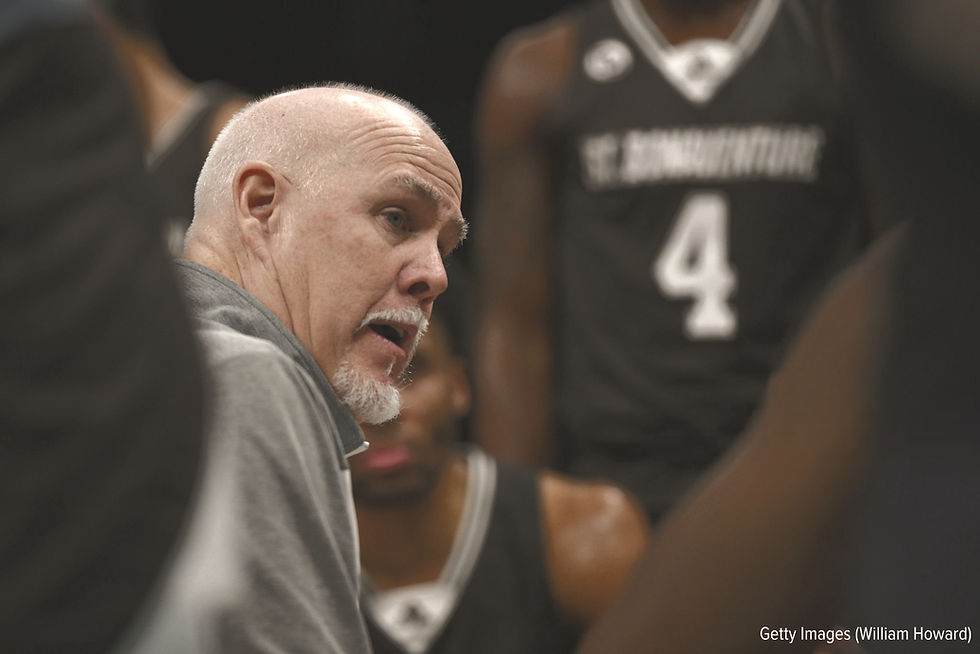
TO UNDERSTAND what Mark Schmidt means to St. Bonaventure is to understand the last quarter century of Bonnies basketball.
In the program’s depths of hell, most outside opinions carried the same refrain.
“After the scandal, everything you built was destroyed,” a Xavier fan wrote on an Atlantic 10 forum during SBU’s 2007 coaching search.
“There is nothing left, and the deck is stacked against you. I'd love to see SBU get successful again, but it simply won't happen.”
Just five years later, that fan watched the Bonnies beat his Xavier team to claim their first Atlantic 10 title, scaling a mountain many thought they no longer belonged on.
Mark Schmidt wasn’t then-Athletic Director Steve Watson’s first choice. He probably wasn’t in the top 10.
After Anthony Solomon was fired following a 24–88 four-year tenure, the search hit early hurdles. Vermont’s Mike Lonergan and top choice Jeff Neubauer of Eastern Kentucky declined after visiting. Niagara’s Joe Mihalich, Marist’s Matt Brady, and Albany’s Will Brown passed.
When Watson finally turned to Schmidt, the Robert Morris coach arrived with an 82–90 record and no postseason appearances. Few inside or outside Olean saw the hire as program-changing.
To sum up the sentiment in four words: “Start the obituary now.”
Scholarship reductions from an academic scandal earlier in the decade still lingered. The Reilly Center had gone from raucous crowds sparring with John Chaney to apathetic locals more interested in arena hot dogs than the games.
When the Solomon-era deck was mostly cleared, Schmidt inherited a locker room with just three scholarship players: Michael Lee, Tyler Relph, and Tyler Benson. Zarryon Fereti had quit during Solomon’s final season, but eventually rejoined Schmidt’s first nucleus.
Schmidt’s message in his Reilly Center introduction was clear: things wouldn’t change overnight, patience would be required, but St. Bonaventure basketball would be rebuilt into a respectable program.
Unknown at the time, Schmidt had already secured the single biggest piece of that rebuild before coaching a game at SBU.
Year One under Schmidt was not cinematic. The Bonnies won eight games, just one more than the previous season. But there were signs of incremental competence.
One of Schmidt’s earliest stories captures the mindset. That first spring, a player knocked on his office door to say he planned to transfer for “a better social life.”
Schmidt, more or less, told him to get lost. The message was clear: St. Bonaventure is somewhere you choose if basketball and school come first.
Schmidt leaned into that idea, turning perceived geographic shortcomings into strengths by recruiting gym rats who embraced repetition, structure, and accountability.
But Mark Schmidt didn’t only bring the program back from the abyss. He returned it to itself, rekindling relationships and reinforcing the intimate, community-driven identity that makes St. Bonaventure different.
He became part of the community, raising his family there and building lasting relationships with locals.
It took time to learn how to frame that message, but Schmidt eventually came to understand what St. Bonaventure is and how to sell it to the players and families who would embrace it.
Building Something Special
by J.P. Butler
There were several early, enticing moments in which you probably allowed yourself to believe that the St. Bonaventure men’s basketball program, under Mark Schmidt, could be different.
There was the Albany game on Dec. 8, 2007 — Schmidt’s 10th on the Bona sideline — when the Bonnies erased a 10-point deficit with seven minutes left to topple the Great Danes, a victory made sweeter in that it came over coach Will Brown, whose “career suicide” remark when referring to the open Bona job earlier that year would become one of the most infamous of this era.
How about Nov. 23, 2008? That was the day Bona secured a thrilling 64-63 road victory over Rutgers, demonstrating that it now could not only hang with power conference opponents, but beat them. Or perhaps it was later that season, when Schmidt’s group earned a trip to Atlantic City for the Atlantic 10 Tournament with an 11th-place finish, marking the first time Bona had placed above the bottom two in the league standings since 2001-02.
Any one of those instances — or maybe it was an amalgamation of the three — could understandably have been the one in which you said:
There’s hope.
There’s a chance.
This coach might actually prove true the now-prophetic line from his introductory press conference when Schmidt said matter-of-factly, “I didn’t take this job to lose. We’re going to build this thing brick by brick. And we’re going to do it right. … We’re going to bring St. Bonaventure back.”
And that’s fair. But it was actually in October 2007, two months before the Albany contest and before Schmidt had ever coached a game here, that the fates of the North Attleboro, Mass., native, the St. Bonaventure program and its loyal followers began to change.
For the better.
For the next two decades.
And, in some respects, forever.
That’s when Bona received a verbal commitment from a long, lanky and low-spoken Canadian kid named Andrew Nicholson.

THE ORIGIN story, by this point, is well-documented.
Jeff Massey, the then-Bona assistant who was sent to Ontario by Schmidt to watch Nicholson play, was at first skeptical of this 6-foot-9 “human Gumby” with size 18 sneakers, but quickly became smitten after watching the power forward display the kind of skill and aptitude that would come to define him.
Massey raced out of the gym to call Schmidt.
“When I saw him, I got goosebumps,” the longtime Bona coach recalled of his first encounter with Nicholson, who landed at St. Bonaventure due, in part, to a sprained ankle that had forced him to miss that summer’s AAU circuit (and to accidentally stepping on his phone, which left him unreachable to many coaches). “You could tell right away that he was going to be something special.”
He would be special. And so, in turn, would Schmidt and the Bonnies.
BEFORE October 2007, Bona was still very much reeling from the Jamil Terrell eligibility scandal from four years earlier.
The Bonnies had gone 24-88 under previous coach Anthony Solomon. They were uncompetitive, navigating NCAA sanctions and playing in a mostly-empty Reilly Center. A pall had been cast over the program; an air that made them not just the A-10’s standing joke, but threatened their conference livelihood.
After March 2012, of course, things changed entirely.
Over the next decade, Bona enjoyed one of its most golden eras, winning two A-10 Tournament championships and two regular season titles, making three NCAA Tournaments (and coming within a historic raw deal and missed Nelson Kaputo 3-pointer of an incredible FIVE trips to the Big Dance), posting five 20-win seasons, cracking the AP Top 25 (who could forget waking up on Thanksgiving morning 2021 with Bona ranked No. 16 nationally?), advancing to one NIT semifinal and producing two A-10 Players of the Year.
And, yes, others helped build that bridge from wholly hapless to Atlantic 10 Power.
Michael Lee and Tyler Relph, perhaps, were the columns. Jonathan Hall and Chris Matthews were the girders. Jaylen Adams and Matt Mobley, later, became the Golden Gate towers.
But the foundation was unequivocally Nicholson.
And the architect, then in his mid-40s, was Mark Schmidt.
IN THOSE still-early days, remember, Nicholson was known as “The Professor.”
He chose St. Bonaventure due partly to the then-newly constructed William F. Walsh Science Center on campus and because it would allow him to maintain his focus on academics. He was — quite incredibly, given what he’d go on to accomplish — a chemistry-turned-physics major. (“Coach used to tease him about coming to practice with a lab coat on,” former teammate Michael Davenport recalled laughingly.)
The Mississauga, Ontario, native, however, also selected Bona because of Schmidt … and because he wanted to help the Bonnies rebuild. “I wanted to go somewhere where I could make a difference,” he said.
And make a difference — one of the most profound in program history — he did.
Together, slowly at first, Schmidt and Nicholson authored those initial moments that would bring fans back, return the program to contention and allow both to beam with that unmistakable Bona pride once more. There was Nicholson’s 22-point, eight-rebound, nine-block brilliance in a double-overtime road win over Bucknell in December 2008; that epic four-OT triumph over Ohio in December 2010 when Nicholson, playing all 60 minutes, racked up 44 points, 12 rebounds and five assists; and that thrilling 98-93 two-OT Senior Night victory over Saint Joseph’s on Feb. 29, 2012, which clinched Bona the No. 4 seed and a double bye at A-10s, when the senior power forward tallied 32 points and 14 boards.
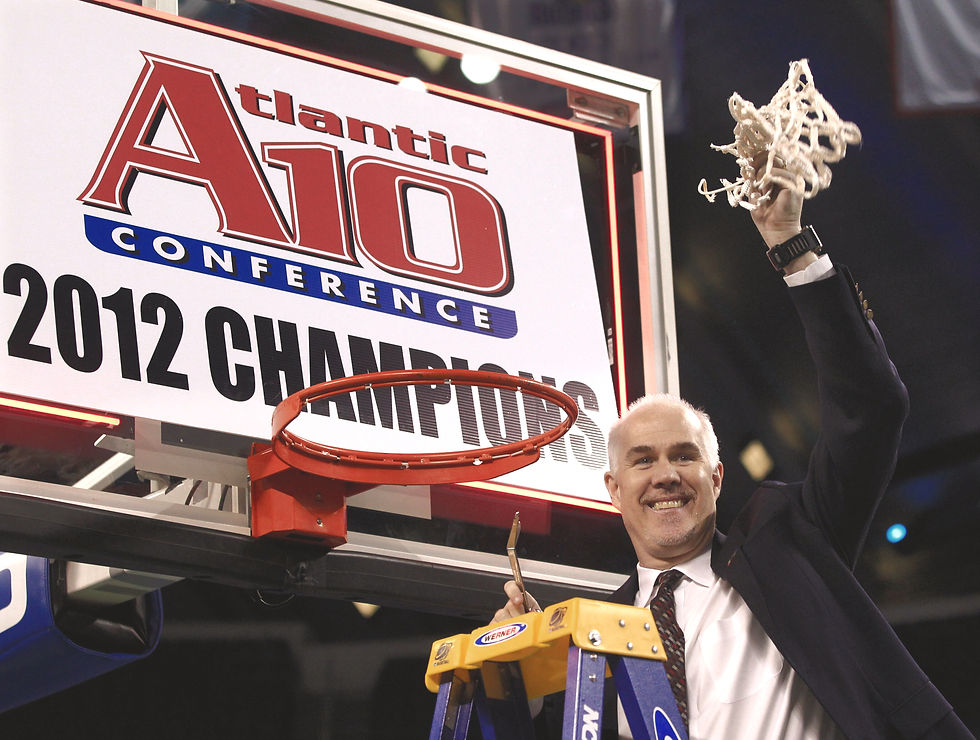
That was followed immediately, of course, by the first program-changing sequence under rapidly rising coach and star player: The Bonnies’ three-game run through the 2012 Atlantic 10 Tournament, which culminated in a 67-56 victory over Xavier for SBU’s first conference title and, under the circumstances, Nicholson’s magnum opus:
Twenty-six points. Fourteen rebounds. Eight blocks. The tournament's Most Outstanding Player.
“I remember when Coach Schmidt recruited me,” Nicholson said shortly after the confetti had fallen inside Atlantic City’s Boardwalk Hall. “And he said you could be a special player. You can do something. I wanted to go to a school where I could make a difference. It shows today that we did it.”
And though he’d arrived at Bona as “The Professor,” Nicholson exited the program a week later — after the Bonnies’ heartbreaking first-round loss to Florida State in the NCAA Tournament, their first appearance in 12 years — under Schmidt’s guidance, with a new moniker:
“The Savior.”
“That’s a hard question,” answered Schmidt, when asked during the postgame press conference following the Bonnies’ win over Xavier if Nicholson was the best player he’d ever coached.
“But I’ll tell you, he’s the best player I’ve ever coached as a head coach. He’s everything for us. Someone asked me before I walked in if he’s better than Bob Lanier. I can’t tell you if he’s better than Bob Lanier, but I can tell you he’s OUR Bob Lanier.”

THE BONNIES’ 2012 A-10 championship remains one of the crowning achievements in the illustrious 19-year Mark Schmidt era.
But aside from how much fun it was — how incredible it felt to see Bona emerge, against long odds, from the ashes of scandal and ascend to the top of the A-10 mountain (and remain at or near the summit for the next decade) — here’s what’s truly interesting about that stretch in retrospect:
It was only the beginning.
It was merely the prelude to the immense glory that would follow.
It was the blueprint to which Schmidt would continue to abide, one that by 2022 was responsible for the former Robert Morris boss to be almost universally described as one of the best coaches in the country, for Bona not only overcoming, but thriving in the face of budget constraints and for the Bonnies becoming one of the Atlantic 10’s elites alongside Dayton and Virginia Commonwealth.
Schmidt succeeded by taking under-the-radar (mostly high school) prospects and developing them into A-10 standouts. Nicholson himself went from scoring two points in his first collegiate game against Schmidt’s former team to being the No. 19 pick, by the Orlando Magic, in the 2012 NBA Draft.
He got guys to play for him, and went seemingly to the ends of the Earth to do so, whether it was Ontario, Canada, the Canary Islands (Charlon Kloof), Carson, California (Dion Wright), Senegal by way of Maine (Youssou Ndoye) or Allen Community College in Kansas (Courtney Stockard).
Then he got them to buy in.
He was tremendously prepared, a gifted tactician and an expert motivator.
With Schmidt guiding the way, those teams — in his ever-familiar words — “learned to win by winning.” And behind him, the Bonnies substantiated another statement that Schmidt had made in his inaugural address: “There is tradition here, it’s not like it’s a graveyard,” he declared on that spring day. “It would be different if nobody had ever won. But guys have won.”
And then so did Schmidt, to an astonishing and almost unprecedented degree.
THIS, WE KNOW, was a zenith that began with Schmidt’s arrival in April 2007.
It became real, even if we didn’t know it at the time, with the commitment from Nicholson six months later.
And it will live forever with the two individuals who spawned it — Schmidt and Nicholson — inextricably linked … and arguably conjoined as two of the four members of St. Bonaventure’s all-time Mount Rushmore, alongside Bob Lanier and Tom Stith.
“He meant everything,” Schmidt said of Nicholson at Andrew’s jersey number retirement ceremony in February 2014. “He’s the one that got us back to respectability. He was somebody that did it the right way. He’s somebody that epitomizes what we’re trying to do here from a student-athlete perspective.
“He brought us back. You can’t just say one guy did it, but he was a huge part of it.
Where we started it and now where we’re at, he really helped build the program. Everything that I have and everything that we have here at Bonaventure from a basketball perspective really begins and ends with Andrew.”
A Modern Golden Age
by Chuckie Maggio

MARK SCHMIDT ecstatically strolled across University of Dayton Arena’s Blackburn Court, applauding and fist-pumping and even waving an imaginary lasso to celebrate a confirmed trip to Texas.
Less than a minute later, Schmidt choked up at the thought of his St. Bonaventure team defeating UCLA. The longtime Bonnies head coach dedicated the First Four victory, the program’s first NCAA Tournament victory since 1970, to Bob Lanier. That 1970 team had national championship aspirations until Lanier, the soon-to-be No. 1 NBA Draft choice, injured his knee in the Regional Semifinal against Villanova. Bona lost the National Semifinal to Jacksonville, missing its chance to prevent UCLA’s fourth of seven consecutive championships.
Bona, 48 years later, defeated the Bruins in the First Four in front of 12,336 in-house fans and 1.7 million television viewers. You could forgive an outsider from watching that postgame interview and confusing the Boston College alumnus for a lifelong Bonnie. “It can’t get better. … This is for him,” Schmidt remarked, referring to Lanier.
It couldn’t get better than that 2017-18 season and it couldn’t get better than Bona basketball’s modern golden age. If the 2012 Atlantic 10 championship reintroduced the program to college basketball, the teams led by point guards Jaylen Adams and Kyle Lofton solidified it, creating indelible memories in the process.
Despite his veteran roster, the 2017-18 run is a candidate for Schmidt’s best coaching job. The Bonnies, after a 2-4 slide to begin league play threatened their NCAA Tournament chances, needed to win every game from Jan. 24 to March 9, just to make the First Four. That span included five road games, including VCU’s vaunted Siegel Center; a Friday night meeting with the No. 16 team in the country, which hadn’t dropped an A-10 game yet; a triple-overtime classic with the other co-Atlantic 10 Player of the Year and his team, coached by a Naismith Hall of Fame nominee; and six games decided by six points or fewer.
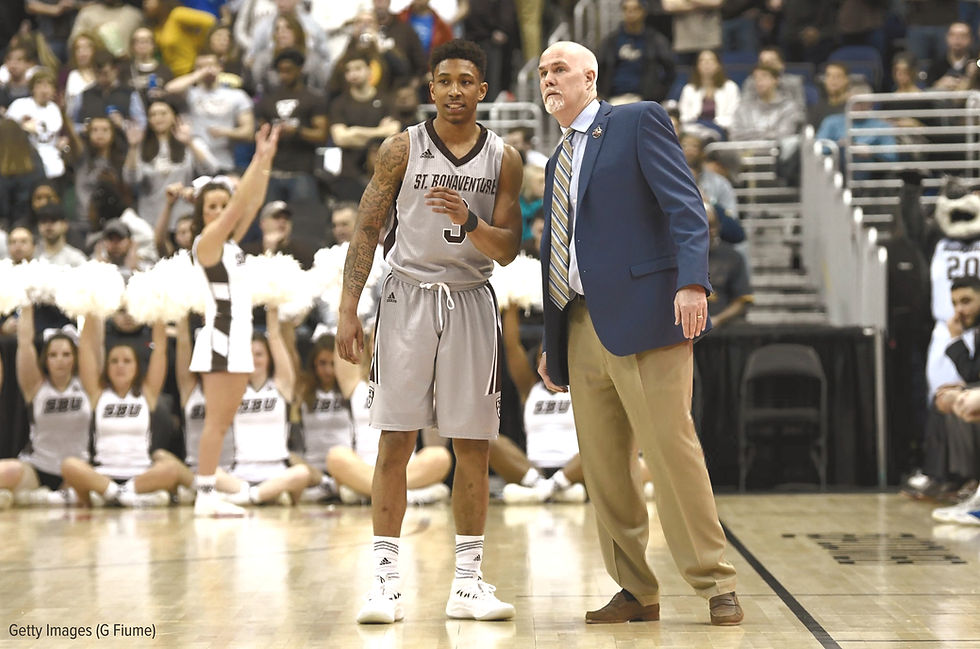
Schmidt termed each contest during that 13-game win streak a “Game 7.” He extracted the best from his players, finishing the Davidson game with a lineup that never played together before or after that triple overtime (Nelson Kaputo, Matt Mobley, Izaiah Brockington, Amadi Ikpeze and Tshiefu Ngalakulondi, for those playing at home) and enjoying Adams’ mastery of his offensive system, featuring two 40-point performances in five days.
He motivated his team through compelling speeches, often embracing the disrespect tag. Before that UCLA game, he scoffed at the notion his group should be intimidated.
“Intimidated, for what?” he emphasized, as captured by videography wiz Asa Johnson. “We’re here for a reason; we deserve to be here. And we’re gonna play.”
He struck a similar but more personal tone before Bonaventure knocked off Syracuse in overtime three months prior.
“Every game (against Syracuse), we have to play here,” he commented sternly, “‘cause they think they’re better than us. You guys have worked your whole life as a basketball player for an opportunity like this. Don’t have any regrets. In two hours, fellas, we’ll be sitting here, and you have a chance to have one of the biggest victories in this school’s history.”
There wasn’t much sitting postgame; the team eschewed the locker room benches and jumped around instead, spraying water and even symbolically disposing of some oranges. Schmidt became the first, and thus far only, coach to lead Bonaventure to a Carrier Dome victory.

St. Bonaventure’s remote location and rugged climate provided rival coaches negative recruiting fodder. Schmidt and his staff used it as an asset, selling a hooper’s development dream tucked behind the Allegheny mountains.
Schmidt sold it as only he can.
“There’s a gym open at all hours of the day,” he often remarked. “When you leave class, you can turn left to the dorms to hang out with your girlfriend or you can turn right to go to the gym. I want guys who want to turn right and go to the gym.”
His players often turned right. Bonaventure’s .667 win percentage from 2015-16 to 2021-22 ranked third-best in the A-10, narrowly behind Dayton (.689) and VCU (.677). That included a 77-21 (.786) home record and 92-42 (.687) record against league opponents.
The 2018-19 season, meant to be a transition year, proved another example of Schmidt and his assistants’ penchant for player development. Expectations plummeted after a 1-5 start, including a Cayman Islands 0-fer. The team didn’t earn a win over a team outside of the MAAC, SWAC or MEAC until Jan. 9.
During the last half of February, however, the Bonnies pieced things together. They won seven of their last eight regular season games, earning a double-bye in the A-10 Tournament after a ninth-place Media Day prediction. They rode that momentum, defeating George Mason and Rhode Island by double-digits to reach the A-10 title game.
Bonaventure became the first, and remains the only, team to reach the league tournament final with three freshman starters. A crushing loss to Saint Louis in that game only delayed, rather than denying, Lofton, Osun Osunniyi and Dominick Welch from reaching the NCAA Tournament. Along with game-changing transfer Jalen Adaway, they won the “double,” claiming both the outright regular season and conference tournament championship, two years later.

EVEN WHEN Bona disappointed during that era, failing to return to the Big Dance in 2021-22, it found a way to matter in March. Three NIT wins, all on the road against Power 5 opponents, punched the program’s ticket to Madison Square Garden for the NIT semifinal.
The university endured off-court trials during those happy seasons. Sister Margaret Carney, the president who hired Schmidt along with athletic director Steve Watson in 2007, revealed a cancer diagnosis in February 2016, shortly after she announced her decision to retire that July. Dr. Dennis DePerro, the school’s president from 2017-21, died on March 1, 2021 after complications associated with Covid-19.
The head coach represented the school with aplomb in those challenging moments. When the Bonnies won the 2021 A-10 Tournament in Dayton, he saved one of the nets for DePerro’s family.
Schmidt said in his postgame press conference on Saturday that if he was just known as “Coach Schmidt,” he hasn’t lived. While he may always be known best as a coach, his impact on the Bonaventure and Buffalo communities already exceeds the boundaries of the Reilly Center or his famously thick playbook.
Schmidt received the Coaches vs Cancer Champion Award at the Final Four for his efforts on the organization’s national board and his fundraising contributions. The 716 Golf Classic he established in Olean has helped raise over $400,000 for cancer research since 2021. He often called fans and alums battling the disease to chat and express his support.
Schmidt won’t be pacing the Bonaventure sidelines, rapidly scribbling on his whiteboard or calling his “use-it-or-lose-it” timeout at the end of first halves next season. The legacy he created in his 19 seasons at the helm, however, will live on wherever Bonaventure fans and players can be found.
Idris Taqqee, a captain on that 2018 NCAA Tournament team who served as a graduate assistant coach himself on former Bona assistant Dave Moore’s West Georgia staff, lauded Schmidt for sharpening his attention to detail.
“Preseason before my sophomore year, we came in at 6 a.m. for at least a month until a percentage of the playbook was perfected. ‘You don’t set the screen there! You set it here (as he steps two feet forward). That’s the difference between winning and losing!’” Taqqee recalled Schmidt imploring the team. “Now we all know.”
“Two inches, two feet or two miles,” Taqqee continued, “it’s the difference between being forgotten or being remembered forever.”
The Cost of Change

IF BEATING Xavier and cutting down the Boardwalk Hall nets in 2012 was the dawn of Schmidt’s decade of consistency (eight straight Atlantic 10 seasons with double-digit wins from 2015 to 2022), then losing to Xavier in the 2022 NIT semifinals at Madison Square Garden was dusk.
Schmidt and the Bonnies reached MSG with a dramatic win at Virginia, but the following day, on the trip back from Charlottesville, became one of the more confusing and chaotic of his tenure.
“Sources: UMass reaches deal with Mark Schmidt for $1.8 million a year. Should be announced next week. — Mark Blaudschun (@blauds), March 23, 2022”
Despite those reports, Schmidt stayed at St. Bonaventure, with then-AD Joe Manhertz securing a new five-year deal. A no-brainer at the time, it also fueled hope of a fifth year with Lofton, Osunniyi, and Welch.
What followed that extension and Bona’s loss to Xavier, unsettling in the moment, soon became the norm at SBU and across the sport.
Adaway declared for the NBA Draft, and the portal flood followed: Jaren Holmes has entered the transfer portal. Linton Brown has entered the transfer portal. Quadry Adams, Abdoul Karim Coulibaly, Oluwasegun Durosinmi, and Joryam Saizonou have entered the transfer portal.
Lofton, Osunniyi, and Welch initially planned to stay, and alums helped assemble a workable NIL package, but offers from Florida, Iowa State, and Alabama ultimately pulled them into the portal just days before the deadline, leaving the staff in limbo.
“When these kids leave, it’s not like you’re upset with them,” Schmidt said. “When Osun left and that whole class... where these kids are from. Osun was offered $400,000. He made $400,000 at Iowa State. How can you tell a kid not to do that? You can’t. Four-hundred thousand dollars may be the most money his family has ever seen.
“You can’t not have them go. It would be like malpractice if I told them to stay. We can’t be upset at these kids, because they’re just following the rules. You can’t stop them from earning a living.”
The exodus leading into 2022–23 left the Bonnies ranked dead last nationally in minutes continuity, returning just 0.1% of their minutes (all from Justin Ndjock-Tajore, who played nine minutes in the opener before leaving the team).
Schmidt and his staff regrouped heading into 2023–24, returning Chad Venning, Daryl Banks, Moses Flowers, Barry Evans, Assa Essamvous, and Kyrell Luc, while adding Noel Brown and eventual starters Mika Adams-Woods and Charles Pride. The roster was the oldest in the country, among the deepest of the Schmidt era, and returned over 63% of its minutes (31st nationally).
Despite a .500 conference finish, Bona won 20 games and reached Schmidt’s sixth Atlantic 10 semifinal. But one of the defining storylines became the games it didn’t play.
With mounting injuries and the portal opening on Selection Sunday, multiple Bonnies entered immediately, leaving Schmidt with a depleted roster and little choice but to avoid an NIT bid.
Schmidt put it plainly: “What coaches do, and we did it as well, we had our exit interviews on (Selection) Sunday because we knew guys were gonna put their names into the portal on Monday. That was the whole thing that happened with the NIT … we didn’t have a team.”

IN THAT CONTEXT, Manhertz and Schmidt asked the NIT not to consider Bona after its A-10 semifinal loss, a move that ultimately came off as a “snub,” which unraveled when ESPN later listed St. Bonaventure among teams declining bids, forcing Manhertz to acknowledge the school had opted out and sparking backlash. He compounded it by telling students he didn’t expect such a reaction, and amid reports he was job-hunting and unfamiliar with Bona’s culture, his tenure ended quickly.
The one-time transfer model that briefly offered roster stability quickly disappeared. In April 2024, the NCAA moved to effectively unlimited transfers without a sit-out, ending the idea of developing players like Kyrell Luc or Anquan Hill over multiple seasons.
Coaches were forced to adapt again, but adaptation now depended largely on the depth of donor pockets or, in Bona’s case, getting creative through outside-the-box means.
It was no secret Schmidt lamented what he called “speed dating” in the transfer portal era. A program built over nearly two decades on finding, recruiting, and developing under-the-radar players like Dion Wright and LaDarien Griffin was, in many cases, replaced by refreshing a portal page, calling agents, and trying to win a week-long bidding war. Even commitments no longer meant what they once did, as Schmidt learned with Noah Waterman, who flipped to BYU for more money after his visit and commitment and never stepped foot on campus again.
And so, as was the main headline across the sports world on September 18, 2024, longtime ESPN senior NBA insider Adrian Wojnarowski arrived, taking on a newly created general manager role. Schmidt could focus on coaching and teaching, while Woj handled the portal, agents, and fundraising, using his relationships to open new pipelines. At the time, the pair seemed like a perfect marriage.
“When you follow the program as closely as I do, you know the values that Mark has in players,” Wojnarowski said. “You know what a Bonaventure player looks like, acts like. A big part of this is just bringing him options.”
Schmidt didn’t hide the excitement. “Guys, we got Woj,” he said with a smile at an introductory press conference on campus. “If Woj put his name in the portal, there’d be Kansas, Carolina, and Duke after him. This is a grand slam.” Athletic director Bob Beretta called it “a big, bold move,” and Schmidt added, “The relationships that Woj has, we couldn’t develop in the next 50 years.”

That dynamic showed up quickly with Melvin Council, who, despite saying “I’m not in it for the money, I’m in it for the culture, family, and fans… I do feel the best thing is to come back,” ultimately left for a significant offer from Kansas.
Schmidt’s stance remained unchanged.
“At Bonaventure, you can’t have one foot in and one foot out,” he said. “Either you’re in or you’re out… Our program is too special for that.”
A generation later, the message was still clear: St. Bonaventure is somewhere you choose.
The result was another reset: St. Bonaventure brought back just 4.4% of its minutes entering 2025–26 (314th nationally), with only Dasonte Bowen and six total minutes from Xander Wedlow returning for the season.
That backdrop made for an uneven campaign, an 11–1 start undone by close-game struggles, injuries, and a 4–14 league finish that sent Bona to a Wednesday A-10 Tournament game for the first time.
There was no official announcement that the regular-season finale would be Schmidt’s final 40 minutes pacing the Bob Lanier Court sideline.
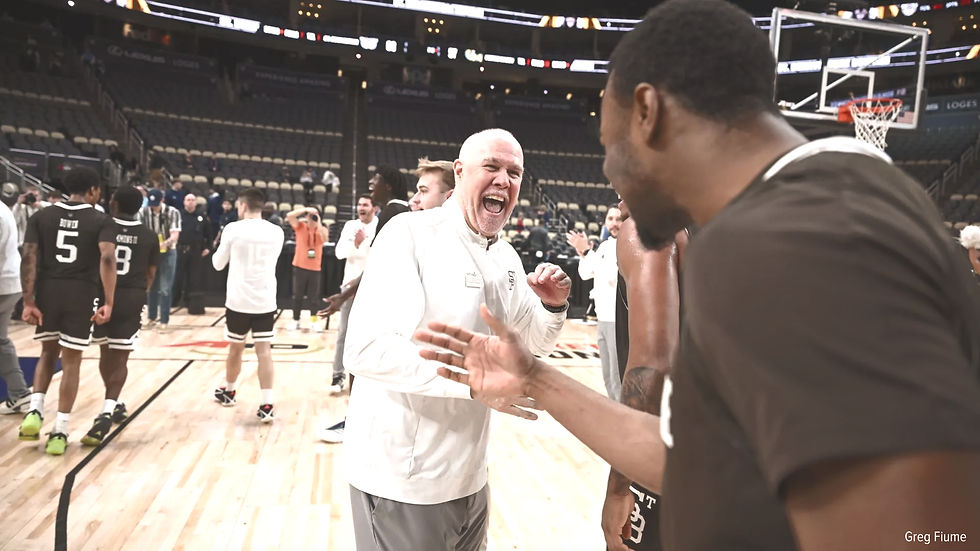
In Pittsburgh, Schmidt’s team delivered arguably its best showing of the season, a 99–80 dismantling of La Salle that belied its status as a 13-seed. After upsetting 5-seed George Mason, a 68–63 loss to Dayton ended the run, but not without praise. “In my opinion, he’s one of the best coaches in all of college basketball,” Dayton coach Anthony Grant said postgame. “The talent he finds and develops, it’s incredible.”
Beretta’s written statement several days later explained the lack of announcement from his perspective: “True to Mark’s admirable, career-long focus on his players, he demurred. He certainly did not want to interfere with Senior Day festivities before the Davidson game.”
The departure, though, was far from clean, carrying more tension than closure. As speculation peaked in the final week of the regular season, even prompting a direct question about his future after the Davidson game, it was framed publicly as a retirement. Behind the scenes, it was more complicated, a business decision that left much of the fan base frustrated with how it unfolded.
Schmidt, for his part, kept the focus where he always has: on the program, its players, and his staff. As he often said, “You’ve never seen a good team with bad players. You’ve seen some good teams with questionable coaching, but you need players.”
“I’m 63 years old and it’s time to move,” he said. “My family has sacrificed for 37 years. It’s time for me to give back a little bit.”
And after nearly two decades building the program back to relevance, he left with a perspective that resonated not just with the Bona Faithful but the broader college basketball community.
“In basketball, it’s consuming. I’m tired of that. I want to travel, spend time with my family, play golf, and drink beer without any consequences. I couldn’t have asked for a better 19 years.”


Comments